Showing posts with label English Paper Piecing. Show all posts

Wednesday, 6 July 2016

La Passacaglia Update: July 2016

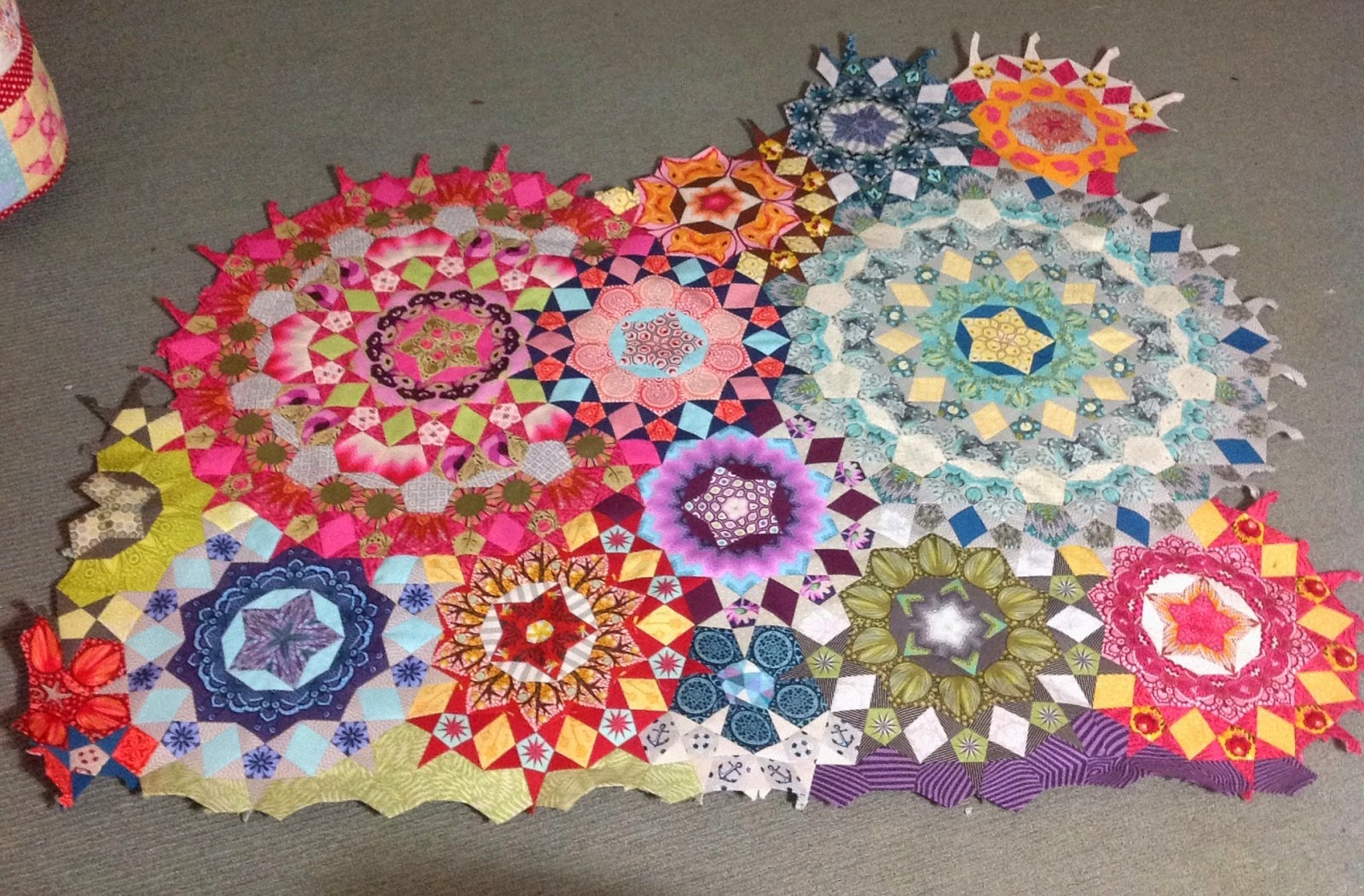
So much for #2015projectoftheyear. This is a large, slow project, but so very enjoyable. Sometimes it gets set aside for other things and that's okay. But when I am working on it, I enjoy every fabric selection, every fussy cut, and every stitch. This is my latest complete rosette:
Heather Ross plus bees Rosette
I've been dragging my feet with this one.  I attempted the single piece centre star, which worked out pretty well, but after adding the bees, I felt like this one just wasn't working.  Too light maybe? And I had no idea what to do for the diamonds in the next round.  I knew I wanted to use the strawberries, but just didn't know what to pair them with.  Then a brainstorm hit, and I pulled out the yellow beehive fabrics and the rosette blossomed from there.  At first, I thought I would end up changing out the centre bit with the frog and the green long diamonds, as I didn't think that the pinks and the greens worked with the outer ring.  But once I got it all put together, I loved it.  Sometimes I overthink things.

I think the small stars were really holding me up from hitting my stride with this pattern. I simply dreaded working on them. But I figured out two things that make them more efficient and therefore more tolerable. Previously, I would stitch each star point onto the pentagon individually, each with an individual thread. Now, I use one thread to sew the points on in a ring around the pentagon. Also, I only attach the bottom four when I am working on a large cog. The top point I attach to the double pentagons above so that there is more straight line stitching in that round, which is much more efficient!
Topless Stars......
There they are!
I have pieces prepped for the next round as well. 
My fussy cut game is on point!
I'll keep working away and will update as I go. It may be soon, it may be a ways off. That is the nature of this project! Follow along on Instagram with #ltslapassacaglia. And if you are working on your own, join the #LaPassPieceAlong!

To see more of this project, check out The Homemade Heart's La Passacaglia Quilt Index

Thursday, 14 May 2015

The Homemade Heart's Guide to English Paper Piecing

I've had some questions about how I make the La Passacaglia rosettes, so I decided to put together a quick tutorial. First of all, I want to assure you that You Can Do It!

English Paper Piecing (or EPP) is very easy, and very accessible, as you don't need any fancy or expensive tools. I will show you what I use, but even that isn't a hard and fast rule, it's just what I have become comfortable with. Adapt and use whatever makes you happy.

The pattern for the La Passacaglia quilt is found in the book Millefiori Quilts by Willyne Hammerstein. 
My well-loved book, and my templates page

My copy came from PaperPieces.com. They also sell the little paper pieces to make the quilt, but you can cut them yourself. That's what I did. I photocopied the template included in the book many times and cut them all out to fit as many as I could on a single page of card stock. Then I cut out all the pieces. Easy peasy. You need many more of the "E" triangles than are in the template, so I used the scraps of the card stock to cut extras. 

These are all the supplies I could possibly use to make rosettes. 
The supplies
1: A carrying case to hold all supplies.
2: A needlebook filled with needles. I like to use "betweens" because I find them to be thin, sharp, and decently sturdy. Also, the eye isn't very large, so it passes through the fabric without making a huge hole. 
3: A Sharpie pen to aid in fussy cutting (see the link at #12 for more info).
4: A small rotary cutter for cutting fabric. Or a large one. Or use scissors. 
5: A glue stick for glue basting. I use good old Elmers. 
6: A compact mirror to aid in fussy cutting. This tutorial helped me immensely!
7: A seam ripper. Because sometimes even the best of us make mistakes and have to rip stitches. 
8: Embroidery scissors for cutting threads. 
9: Thread for sewing. I like Gutermann hand quilting thread because it is so smooth. I chose a light grey that kinda just goes with everything, that way I don't have to constantly be changing thread colours. 
10: Wonderclips make your job so much easier when holding pieces together for sewing. They are strong and small, so they don't get in your way. 
11: Paper pieces. Like I said, you may buy them online, or just cut them yourself from card stock. The ones online are "laser cut" which makes them more accurate than handcut pieces, but I don't find that it makes a difference. I guess it just depends if your time printing and cutting tiny pieces is worth more than just buying a set. You can reuse pieces as well. Once a piece is sewn in on all sides, the paper can be removed. Don't worry about the glue, the fabric peels right off easily. 
12: Fussy cutting templates. I made my own (see this tutorial to DIY your own set). You can buy these online as well, and they are fancy acrylic ones. But I couldn't justify the price, personally. 
13: Fabric scissors. See #4 above. 
14: A needle minder and elastic band. I constantly misplace my needle, so a magnetic needleminder is very helpful to keep it readily available. The rubber band helps when you just put on hand lotion, or your hands are sweaty, and you just can't get a good grip on that needle! Use it as a grip assistant. It will help save your nails too (I find mine get all ragged when I am trying desperately to grab hold of a slippery or tightly jammed needle). 
15: Fabric, to make all your beautiful pieces! 
16: Self-healing cutting mat to use with your rotary cutter. No scratching up your tabletops, and it preserves the life of your blade, too. 

Like I said before, this isn't a hard and fast list. You may scoff at some of my items as frivolous and unnessesary, or you may be outraged that something is missing from my list. Use what you are comfortable with. 

Now that our supplies are all assembled, let's talk about making pieces. 

Your first step is to use those fussy cutting templates and a sharpie pen to locate and cut the pieces from your fabric using your rotary cutter and cutting mat, or scissors. Next, centre and glue down the paper piece onto the wrong side of your fabric. Then, run a thin strip of glue down each side and fold over your fabric edges. This is called glue basting. You can also thread baste (which I used to do), but I find glue basting is much faster. 

Now you are ready to sew. 

Place your pieces right sides together with the wonderclip on the side you will be sewing. Make sure your edges are lined up! I like to thread my needle with one strand folded in half, with the two tail ends through the eye of the needle. 
The Whip Stitch
Then I poke the needle through the right hand corner of the pieces (picture 1), draw it through, then pass the needle through the loop at the end of the thread (picture 2). This way the thread is locked without having to tie knots. Then I move over about an 1/8th of an inch, and poke my needle through again, always from the bottom to the top (picture 3). Keep doing this same stitch, bottom to top 1/8th of an inch apart along the whole edge (picture 4). This is called whip stitch. You want your stitches to be as uniform as you can make them, and try not to poke through the papers. Your are hugging the edge with your stitches. 

When you get to the last few stitches, you want to lock off your thread.

Poke your needle through as usual, but bring the needle back through the loop of the thread where it is entering the piece (picture 1). This secures the thread without tying any knots. Do this for the last 2-3 stitches. When you get to the end, bury your thread in the back of the piece by passing the needle under the seam allowance (picture 2). Make sure you don't go through the paper, or the front of the piece! Trim the thread. Open up your pieces and admire your handiwork (picture 3)! 

I like to go round by round when making my rosettes. I first cut and glue baste all my pieces, then sew them together according to the pattern. Once the round is complete, I attach it to the rest of the rosette, going piece by piece until it is all sewn in. 

This is a super fun project, and I am sure that anyone could do it if they so desired. As you can see, it isn't very difficult, and it doesn't require expensive, elaborate tools. It does take time though. Don't expect to whip through this quilt in a week! This is the kind of project where you savour each step and each stitch. 
My current WIP rosette

If you want to read more about this project, head here for the complete index!

The Homemade Heart's La Passacaglia Quilt Index


I decided to make a post that indexes any new updates on my La Passacaglia Quilt.  This is such a large and time consuming project, I anticipate it being a work in progress for quite some time! Thanks for following along, it means the world to me to hear all your positive praise and encouragement.  And if I can inspire even one person to give this project a go, it makes it all the more special to me.  Happy sewing!

2015 Project of the Year: La Passacaglia Quilt

DIY Fussy Cutting Templates Tutorial

First Rosette: 2015 Project of the Year

2015 Project of the Year: May update

The Homemade Heart's Guide to English Paper Piecing


Wednesday, 13 May 2015

2015 Project of the Year: May update

This La Passacaglia quilt is certainly a very slow task. It very well may turn into a 5 year project! Since starting in January, I have managed to complete my first rosette, start a second with some cotton and steel lions, and made good progress on a Charley Harper themed large rosette. I still have two more rounds to go on the big one before it is complete.
A stack of beauties!
It is quite easy to start a rosette. The centre star and the first ring of pentagons goes quickly and is lots of fun. Then that first row of stars hits, and they are small and a little tedious, and definitely time consuming. And as it gets bigger, the more pieces it takes to complete the round!
This part is easy (and fairly quick)
This becomes much more time consuming!
Thankfully, I am not going for speed with this quilt. I am truly enjoying the process. I love interacting with and choosing the fabrics for each round, and fussy cutting each piece. I love seeing how each cog evolves from the starting idea. And I love handsewing each tiny piece. This is a project that, even if it takes me ten years to complete, will be a beautiful keepsake full of memories and deep connections with the fabrics, the events in my life that coincide with each rosette, and the quilting community on Instagram that has been so supportive and loving along the way.  
In total: 3(ish)!

To read more about this quilt so far, check out these related posts: 

First Rosette: 2015 Project of the Year

DIY Fussy Cutting Template Tutorial

The Homemade Heart La Passacaglia Quilt Index


And the one that started it all: Project of the Year: La Passacaglia

Tuesday, 21 April 2015

Charley Harper Swap pt 2: Outgoing

The #charleyharpersewnstudio swap wrapped up at the beginning of April. My partner finally got the package yesterday (it took 3 weeks to get from Winnipeg to Tennessee - ridiculous!) My partner said that her favourite prints are Foxsimilies, Family owlbum, and Mice Invasion. So I incorporated all of them into the package I sent.
A Charley Harper label to hint at what's inside!
First, the mini quilt. I waffled back and forth about what I wanted to do, until inspiration hit in the shower (where I do all my best thinking). I decided to recreate Family Owlbum as the main feature of the quilt. 
The original artwork

The owls were pretty challenging. I combined a few different techniques to achieve the final project. I used English Paper Piecing to make the large eyes and the baby owls. I used machine and hand applique to attach all the small parts, and embroidery to draw around the eyes. 
The owl family
I used needle turn applique to attach the portrait to the centre of a cream panel, and added four circles of the feathers fabric around the owls. Then I framed the whole thing using the twigs fabric as the corners. 
The front, before quilting
On the back, I attached a label made to look like a Charley Harper nest. 
This is my favourtie label ever
I wanted to make the circles really pop, so I left them unquilted, and did some free motion stiples around them on the cream fabric. And I did straight line quilting in the frame. I attempted machine binding for the first time for this project, because I wanted to try using a decorative stitch on the binding.  I prefer hand binding.  Maybe I'm just not very good at machine binding, but I wasn't thrilled with how it turned out.  
After quilting
Free motion stiples
Binding closeup
Love the pop!
In hindsight, I wish I would have centred the quilt label on the back to coincide with the owl on the front. It ended up half in and half out of the stiples, which I think is less than ideal. 
The back, post quilting
I made a few extras to include with the mini quilt. I made a needle book featuring Foxsimilies during my stay at 52 Quilters.
Those elephants were perfect for the inside!
I made a needleminder from the ladybug fabric.

And I made a pincushion/jar from the Mice Invasion fabric.
Jar and button courtesy of Grandma's hoarding!
I loved putting this package together for my partner. I enjoy Charley Harper's artwork so much, so it was a lot of fun to get to interact with it like this. Thanks Sewn Studio for hosting this super fun swap!

If you liked this post, you may be interested to see what I received in this swap!

Charley Harper Swap pt1: Incoming

And if you love reading about my love for Charley Harper, here's a few other gems for you.

Feelin' Good on a Wednesday: Charley Harper Love!

The Charley Harper Conundrum

The Charley Harper Resolution

Wednesday, 18 February 2015

First Rosette! (2015 project of the year)

I finished my first rosette for my La Passacaglia quilt! 

I used some of my Bluebird Park fabric from Kate and Birdie to put this cog together. It was definitely a challenge to figure out what direction I wanted to go with this. At first, I had a different centre to this cog. 
The original version
I just wasn't feeling it though. I tried auditioning other fabrics, but nothing was really working. 
Neither really works....
So I percolated with it for a while to figure out what was wrong with it. I looked through so many pictures of rosettes that other people had made, and thought a lot about what I liked about them. I realized that one thing I love about these quilts is the beauty in repetition. Another thing I love, is the distinct layers of each cog, like a bullseye. A bold star shape in the middle is a solid base to build upon. 

So when I looked at mine, I felt like it was strong in repetition, but weak in the distinct layers, especially the star. So I picked apart what I had so far and started over with the centre. I changed the middle to make a definite star, and changed the long diamond shapes to the green with a white flower instead of the dark grey linen. The dark grey just blended in too much with the bunnies/butterflies above. Also, the green tied in with the star points so much better. I like the final version much more than the original. 

In the making of this first rosette, I also realized the need for some fussy cutting templates. So I made some (and wrote a tutorial, in case you need some too!). And I also felt the need for a needleminder. I was inspired by @tinkerellen on Instagram to put together a simple magnetic needleminder made from a small wooden fox. 
He fits in well here!
And in case you were wondering what size these pieces are, here is a picture to give you an idea of the scale. 
Tiny!
I have really enjoyed working on this first rosette. The journey so far has been so enlightening, and I loved figuring out what works and what doesn't. I can't wait to keep making more!

To read more about this project, have a look at :

The Homemade Heart's La Passacaglia Quilt Index


Tuesday, 3 February 2015

DIY: Fussy cutting templates tutorial

Since starting this La Passacaglia madness as my 2015 Project of the Year, I have realized the great necessity of reusable clear templates to use for fussy cutting. I see lots of people buying acrylic ones online specifically for this project, but I figured there must be a homemade way around spending $38 (plus shipping) on five pieces of plastic. And guess what? There is! 

Step one: Gather supplies

You will need:
- a sturdy plastic report cover (mine is from the dollar bin at Walmart)
-a ruler
-scissors (but not your fabric ones!)
-a sharpie pen
-a razor blade
-the paper pieces you need templates for

Step two: Trace 

Trace your paper pieces onto the smooth side of the report cover

Step three: Add seam allowance 

Use your ruler to measure and draw a 1/4" seam allowance (or whatever size is your preference) all the way around the tracing. 

Step four: Cut them
Cut out the piece on the outer line of the template. 

Step five: Etch them

Use the razor blade to etch over the inner line. Don't press too hard, you don't want to cut all the way through. 

Step six: Clean them 

Using a damp tissue, wipe clean the marker lines from your templates. 

Step seven: use with confidence! 

To use these templates for very precise serial fussy cutting, place the template over the fabric and centre the area you want to feature. Then use your sharpie pen to trace a couple features of the fabric onto the smooth side of the template. Use this tracing to line up the next piece and cut around it. This way, you can have all of your fussy cut pieces look exactly the same! 

I am so happy I figured out a DIY homemade solution for these templates.  Especially with the Canadian dollar dropping so much right now, I just couldn't justify spending the money on importing the acrylic version.  If you use this tutorial to make a set for yourself, I would love to hear how it goes!

Saturday, 27 December 2014

2015 Project of the Year: La Passacaglia Quilt

Oh my goodness. I can't contain my excitement! My amazing husband got me a wonderful Christmas gift: Millefiori Quilts by Willyne Hammerstein
I have been aching to give one of the La Passacaglia quilts a try, and now I can! He was also a total gifting champ, and bought me not one, not two, but four (!) bundles of fabric collections I have had my eye on. This gives me much fodder for this epic quilt!

La Passacaglia quilts look like a beautiful, colourful kaleidoscope, with so much potential for fuzzy cutting.  They are made using the English Paper Piecing technique, which means they are completely hand sewn. And the total piece count is over 2900! Last night I started cutting up the paper templates. I spent a good three hours at it, and have barely made a dent. 
I plan to have this quilt be a work-in-progress over the next year (or more if necessary!). This on-going project has me very excited, so stay tuned for progress updates!

For the complete list of related posts, head over to :

The Homemade Heart's La Passacaglia Quilt Index


Friday, 26 December 2014

Sewing without a pattern? I too like to live dangerously!

Sometimes I like to live on the wild side. And by this I mean sew something without a pattern. My husband asked me to make a bag for his mom for Christmas to replace the gift bag she has been using to carry her iPad, wallet, and miscellaneous stuff back and forth to work. So I had a general idea about size in mind, but otherwise was working from a figure-it-out-as-you-go place. 


I started off with Bluebird Park from Kate & Birdie Co with Moda Fabrics. I love the colours, textures and adorable animals from this line. In fact, prior to knowing about the fabric collection, I had used cards with the hedgehogs and bunnies for my wedding shower thank yous! 

Next, I decided it would be cute to fussy cut some of these designs into 2 inch hexies to feature them on the bag. I hand sewed them together using the English paper piecing technique. 
English paper piecing means all hand sewing
I decided to wrap this patchwork around the side of the bag to add interest in the front and back. I chose the dark cross hatching fabric to fill in the remaining of the patchwork portion to give contrast to the business of the hexies. I also selected a dark brown to use as the base, handles, and lining of the bag. 
The layout
I used a decorative stitch from my sewing machine to dress up the handles, and the pocket I installed on the inside.
Handles close up
A peek inside - a pocket perfect for an iPad
I used a blanket stitch on my sewing machine to applique the hexies to the background fabric and the base. 
Blanket stitch applique
Initially, I was going to square off the hexies by cutting around the perimeter to make all the lines straight. But when I was laying out the bag, I decided to keep the hexies intact for more visual interest. I think that this was a good idea; I love the way it looks, especially at the top where the handles attach to the hexies.

Front view


Back view
Lastly, I used a magnetic clasp for the closure, and used the blanket stitch to top stitch around the upper perimeter of the bag. I filled the bag with little treats that my mother in law will like, and wrapped it up for Christmas. I sure hope she likes it!